Have you ever caught your reflection in a store window and felt that sudden drop in your stomach because your wig is slowly inching backward? If you’ve ever experienced that mid-day panic, you’re far from alone. Whether you wear a wig for medical hair loss, protective styling, or simply for the joy of fashion, the fear of an unexpected shift is an incredibly common part of the journey. The good news? The solution rarely involves resorting to messy, uncomfortable glue.
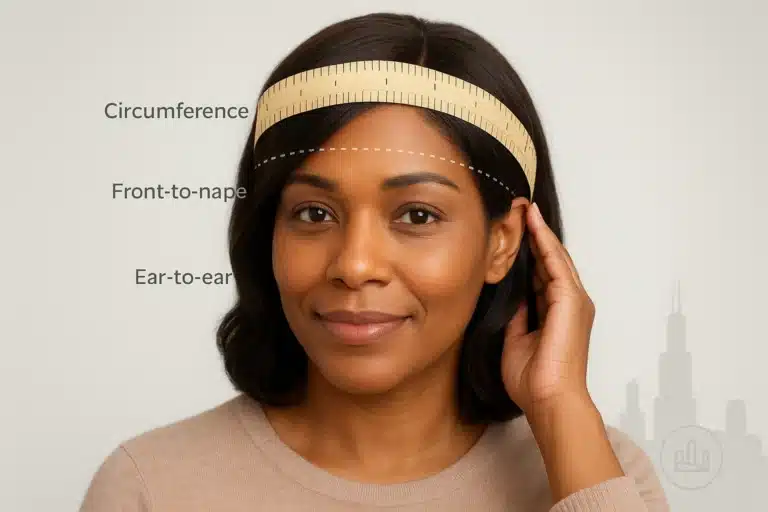
Often, we assume that a slipping wig means we need to pull the straps tighter, but genuine security comes down to understanding the biomechanics of your specific head shape. To ensure your piece remains beautifully stable, you must start with a proper base; this requires mastering wig fit through accurate head measurements and understanding your specific cap size. Once you have the right foundation, preventing the dreaded slip becomes a matter of smart placement and gentle technique.
Let’s dive into the fascinating mechanics of wig security and explore how to transform a nerve-wracking fit into one that feels like a natural extension of yourself.
The Anatomy of a Secure Fit: The 3-Point Check
When diagnosing a wig that won’t stay put, the most successful approach moves beyond generic advice and looks at how a wig interacts with your anatomy. A perfectly secured wig relies on three specific anchor points: the forehead, the temples, and the occipital bone.
The occipital bone is perhaps the most critical, yet least understood, element of wig security. If you run your hand down the back of your head, you’ll feel a distinct curvature or “bump” just before your neck begins. This is your Occipital Anchor. If your wig cap doesn’t cup gently underneath this curve, it is anatomically impossible for it to stay in place without sliding up.
Diagnosing and Fixing Common Fit Issues
If you’re struggling with slippage, your wig is trying to tell you something. Here is a diagnostic breakdown of the three most common fit issues and exactly how to solve them.
Issue #1: The Sliding Nape and the “Nape Trap”
The Symptom: The back of your wig constantly creeps up your neck, bunching at the crown or sliding backward.
The Root Cause: Most beginners fall into what we call the “Nape Trap.” When the back feels loose, the instinct is to crank the adjustable nape straps as tight as possible. However, over-tightening actually causes the wig to lose its grip on your occipital bone. Instead of cupping beneath the curve, the tension acts like a rubber band, popping the wig up and over the bump.
The Fix: Loosen your adjusters. Place the wig perfectly under your occipital bone first, then tighten the straps just enough to lay flat against your skin. If you are still figuring out how to keep your wig from slipping, remember that security comes from cupping, not squeezing.
Issue #2: The Temple Gap and Ear Tab Alignment
The Symptom: The wig lifts away from your face at the sides, exposing your natural hairline or creating an obvious space.
The Root Cause: Temple gaps are rarely a sizing defect; they usually stem from misaligned ear tabs or a bulky “bio-hair foundation.” If you have short, bob-length, or fine natural hair that cannot be easily braided down to your scalp, the bulk pushes the wig’s ear tabs outward.
The Fix: First, ensure your ear tabs are completely level and pointing toward your cheekbones, not your ears. If biological hair bulk is the issue, opt for flattening techniques like a gelled wrap or small, flat pin-curls rather than a low ponytail. Managing the proper wig fitting sideburns gap makes a monumental difference in how natural the wig looks and feels.
Issue #3: The Forehead Lift and the “4-Finger Rule”
The Symptom: The front hairline lifts, rolls back, or feels like it is constantly threatening to expose your wig cap.
The Root Cause: This is almost always an issue of front-to-back placement. When a wig is pulled too far down the forehead, the tension from the back pulls it backward, causing the front to lift.
The Fix: Use the “4-Finger Rule.” Place your index finger perfectly aligned with your brow bone, stacking four fingers flat against your forehead. Where your top finger lands is exactly where your natural hairline begins, and where the front edge of your wig should sit. This placement perfectly balances the tension across the top of your head.
The Accessory Matrix: Creating Friction Without Damage
The wig community is heavily shifting toward “glueless” security, prioritizing scalp health and convenience over chemical adhesives. The secret to glueless wear lies in the science of friction.
A high-quality wig grip—particularly one made of velvet—is often the ultimate problem solver. Why velvet? The nap (the raised surface) of velvet fabric acts as a one-way friction barrier. It mimics the microscopic scales of human hair, allowing the wig to slide on easily but physically preventing it from sliding backward.
- Velvet Grips: Best for everyday wear, sensitive scalps, and those who want an all-day hold without adhesive.
- Silicone Bands: Ideal for active lifestyles or gym-goers, providing a slightly tacky grip that repels sweat.
- Wig Tape: A great option for securing just the ear tabs for special events where maximum wind-proof security is needed.
The “Aha” Checklist: 5-Second Fixes for Wig Slippage
Before you step out the door, run through this quick diagnostic checklist and perform the “Pull Test.”
- Check the 4-Finger Placement: Is the hairline sitting four fingers above your brows?
- Check the Occipital Anchor: Run your thumb under the back of the wig. Is it cupping the bump at the back of your head?
- Check the Ear Tabs: Are both tabs perfectly even and pointing down toward your jaw?
- The Pull Test: Gently tug the hair near the crown forward and backward. It should feel anchored, moving your scalp slightly rather than sliding freely over your head.
Frequently Asked Questions About Wig Security
Why is my wig sliding back on a bald head?
Without natural hair to provide friction, wigs tend to slip smoothly over a bare scalp. Utilizing a velvet wig grip or a silicone headband creates the necessary friction barrier. Ensure you aren’t relying on the adjustable nape straps alone, as a bare scalp requires an even distribution of tension.
Can I secure a wig if my hair is too short to braid?
Absolutely! If your hair is too short for a flat braid-down, use a strong-hold gel to mold the hair flat against your scalp in a wrapping motion, securing the ends with flat bobby pins. A wig cap placed securely over this wrap will create the smooth foundation you need.
Do I have to use glue or tape every day?
No. In fact, many daily wig wearers never touch glue. By combining an accurate cap size, the Occipital Anchor technique, and a quality velvet grip, you can achieve complete security that is both comfortable and entirely glueless.
Next Steps on Your Wig Journey
Experiencing hair loss or navigating the world of alternative hair is a deeply personal journey, and physical comfort should never be a luxury. A wig that fits beautifully does more than just look good—it frees up your mental energy, allowing you to focus on your day rather than your hairline.
Take the time to experiment with the 4-Finger Rule, locate your Occipital Anchor, and try out friction-based accessories. As you practice these techniques, you’ll naturally transition from feeling anxious about slippage to feeling empowered and beautifully confident in your perfect fit.