There is a specific feeling of anticipation when you first unbox a new wig. It arrives pristine, perfectly coiffed, and ready to wear. But for many of us, that “out-of-the-box” perfection can actually feel a little too perfect. It might sit a bit heavy, the bangs might fall just past your comfort zone, or the density might feel overwhelming compared to your biological hair. This is where the magic of customization begins.
Understanding that a wig is a starting point rather than a finished sculpture is a pivotal moment in your hair journey. Whether you are looking to trim the bangs to frame your face or create a messy bun for a casual grocery run, personalizing your piece is the key to making it feel truly yours. Before you reach for the scissors, however, it is helpful to understand the fundamentals of selecting a piece that aligns with your lifestyle. For a comprehensive overview on making that initial choice, take a look at The Definitive Guide to Hairdo Wigs: Choosing Your Perfect Style with Confidence, which lays the groundwork for the customization techniques we are about to explore.
The Foundation: Understanding Tru2Life Heat-Friendly Fiber
Before we discuss cutting or pinning, we need to talk about the canvas you are working with. Most Hairdo wigs are crafted with Tru2Life heat-friendly synthetic fiber. This is a game-changer compared to traditional synthetic wigs, but it requires a specific “physics” lesson to manipulate correctly.
The “Cool-to-Set” Rule
The biggest mistake beginners make with heat-friendly synthetic hair is treating it like human hair. When you curl human hair with a hot iron, the heat creates the curl. When you use heat on Tru2Life fiber, the heat merely makes the fiber pliable. The curl is actually created during the cooling process.
If you wrap a strand around a curling iron and release it while it’s hot, gravity will pull it straight immediately. To achieve waves or curls, you must:
- Heat the fiber (keeping the tool below 350°F).
- Hold the curl in the desired shape (pinned or in your hand).
- Wait until the fiber is completely cool before releasing.
Think of it like candle wax; it only holds its new shape once it hardens. This property is what allows you to change the texture of your Hairdo wig from straight to wavy and back again, giving you versatility that standard synthetics simply cannot offer.
The Cutting Room: Customizing Your Cut Without Fear
The idea of taking scissors to a wig can be terrifying. Unlike biological hair, wig hair doesn’t grow back. However, a few strategic snips can make the difference between wearing a wig and “slaying” a look. By following a risk-mitigation framework, you can customize with confidence.
The Golden Rule: Only Cut Dry
Never, under any circumstances, cut synthetic hair when it is wet. Synthetic fibers can stretch when wet and bounce back when dry, leading to uneven, jagged lines. Always place the wig on a canvas block head or a wig stand and style it as you intend to wear it before you start cutting.
Technique: Point-Cutting vs. Blunt Cutting
To avoid the “doll hair” look—where the ends are thick, heavy, and unnatural—avoid cutting straight across (blunt cutting). Instead, use a technique called point-cutting.
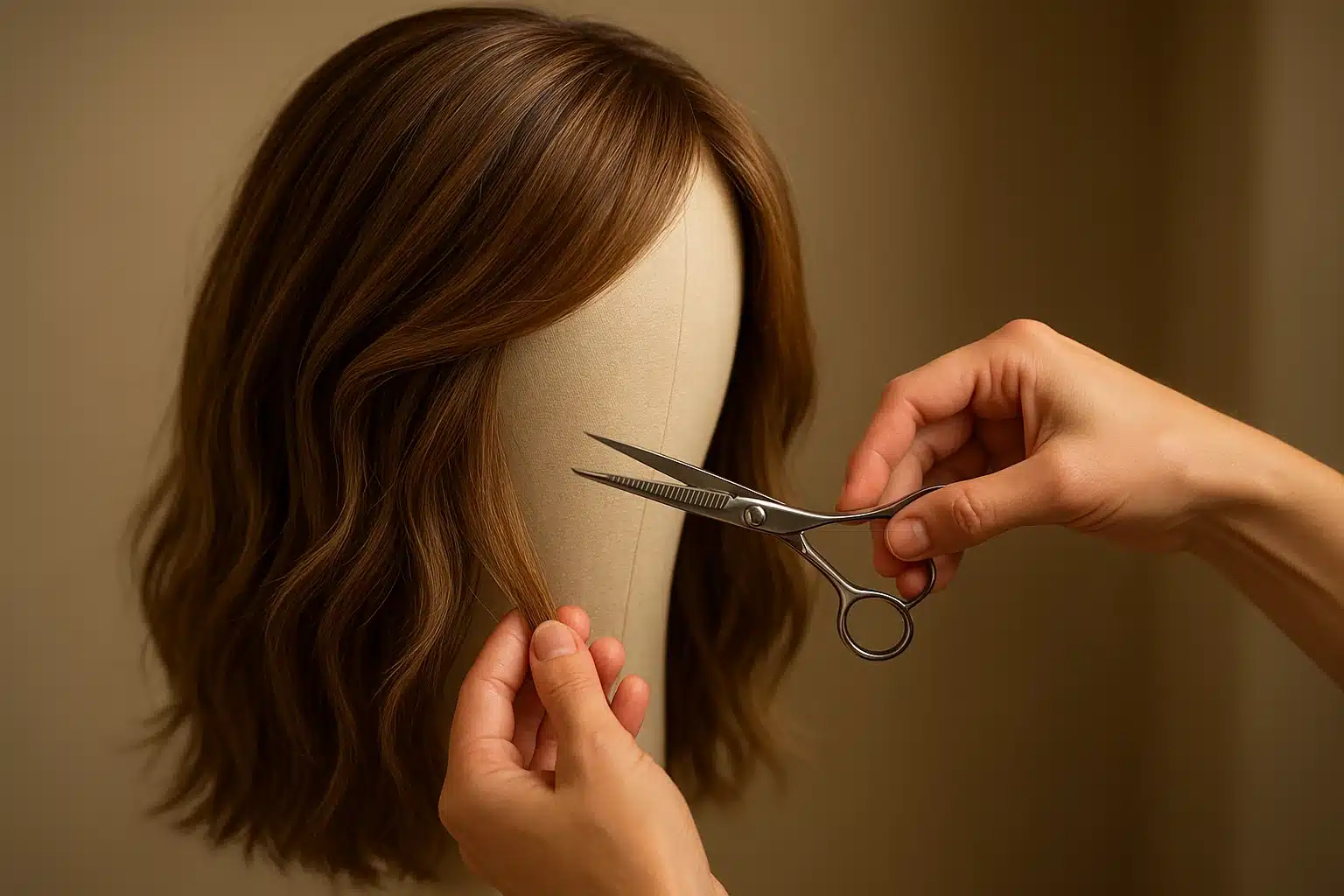
Hold your scissors vertically, pointing up into the ends of the hair, and make small snips. This removes length while simultaneously shattering the edge, creating a soft, feathered finish that mimics the way natural hair grows. This is particularly crucial if you are trimming bangs.
Bangs 101: The Safety Zone
If you want to cut bangs into your Hairdo wig, start long. A good rule of thumb is the “Eye-Level” safety margin. Cut the hair so it falls at the bridge of your nose first. You can always take more off, but you can’t put it back. Cutting bangs while wearing the wig (carefully!) is often the best way to ensure they frame your unique face shape correctly.
Volume and Movement: De-Bulking the Right Way
A common sentiment among new wig wearers is, “There is just too much hair!” Manufacturers often include extra density to ensure the wig cap is completely hidden, but this can result in a “poofy” look.
To reduce volume, you need thinning shears (scissors with teeth on one blade). The secret is strategic thinning from underneath.
- Section off the top layer of the wig (the “crown”). Do not cut this layer, as short hairs here will stick up and be visible.
- Lift the layers underneath.
- Use the thinning shears about 2-3 inches away from the root to remove bulk from the mid-lengths and ends.
This allows the top layer to lay flatter against the head, providing a much more natural silhouette without compromising the coverage of the wefts.
The Updo Lab: Creative Styling and Nape Concealment
One of the great advantages of Hairdo wigs is their construction, but putting a wig into a high ponytail or updo presents a specific challenge: the “false back” hairline. If you pull the hair up too tightly, you expose the edge of the wig cap at the nape of your neck.
The Loose Tendril Strategy
To create a realistic updo:
- Keep it low and loose: Styles that sit at the occipital bone (the bone at the base of your skull) are safer than high ponies.
- Pull out baby hairs: Gently tease out small strands of hair around the ears and nape.
- The “Messy” Aesthetic: Perfection is the enemy of realism here. A messy bun or a loose chignon looks more natural because the slight disarray hides the cap construction.
Achieving the “Wet Look”
The “wet look” is a popular high-fashion style, but using standard gels on synthetic hair can ruin the fiber, causing permanent clumping and white residue. To achieve this safely on your Hairdo wig:
- Avoid alcohol-based products, which dry out the fiber.
- Use a water-based silicone spray or a specialized wig styling cream.
- Mist the hair with water, apply a dime-sized amount of wig cream to your palms, and rake it through the hair to create separation and shine without the crunch.
Frequently Asked Questions
Can I use my regular hair straightener on a Hairdo wig?
Yes, provided it has a temperature control. You must keep the heat between 275°F and 300°F (never exceeding 350°F). If your straightener only has “Low/High” settings, it is safer to invest in a tool with digital temperature control to avoid melting the fiber.
How do I stop the ends from frizzing after I cut them?
Friction is the enemy of synthetic fiber. If you have cut layers, the ends may rub against your clothing. Applying a small amount of wig-specific detangler or serum daily can create a protective barrier. If frizz occurs, using a steamer on the ends can often smooth the fiber back out (a technique known as “steaming out the frizz”).
Can I dye my Hairdo wig if I want to change the color?
Generally, no. Synthetic fibers are like plastic fishing line; they do not have a cuticle to absorb color like human hair. While some DIY enthusiasts experiment with fabric dyes, the results are unpredictable and can stain the lace cap. It is much safer to purchase a wig in the desired shade.
Your Styling Journey Continues
Customizing your wig is not just about maintenance; it is about ownership. It is about taking a mass-produced item and tailoring it to your unique features and personality. Whether you are steaming out a box-hair kink, point-cutting a fringe, or mastering the art of the low chignon, every adjustment builds your confidence.
Remember, the goal isn’t to make the wig look like a perfect picture in a catalog—it’s to make it look like you. Start with small changes, use the right tools, and enjoy the versatility that your Hairdo wig provides.