When you first start exploring the world of wigs, the variance in pricing can be startling. You might see two wigs that look nearly identical on a model, yet one costs $150 and the other $600. For anyone navigating hair loss or looking for a style change, the natural instinct is often to save money upfront. However, viewing a wig merely as a purchase rather than an investment can actually cost you more in the long run.
Understanding the economics of hair replacement requires a shift in perspective. When you are budgeting for your perfect wig, it’s easy to get fixated on the sticker price, but the true value lies in the “Cost-Per-Wear” (CPW). Just like a high-quality pair of shoes that lasts for years versus a cheap pair that needs replacing every few months, the construction of your wig cap plays a massive role in how long your investment lasts—and how comfortable you’ll be while wearing it.
The “Sticker Price” vs. “Cost-Per-Wear” Reality
The most common mistake first-time buyers make is falling into the “Replacement Trap.” This occurs when you purchase a lower-cost item to save money today, only to find yourself replacing it three times as often as a higher-quality alternative.
To understand the real cost of your wig, you need to look at the Cost-Per-Wear formula:(Purchase Price + Maintenance Costs) ÷ Days of Wear = Cost-Per-Wear
Research into wig longevity suggests that while a basic machine-made cap has a low entry price, the friction caused by its construction can lead to fiber degradation much faster than smoother, hand-tied options. If a $150 wig lasts you three months of daily wear, your cost is roughly $1.66 per day. Conversely, a higher-quality construction that lasts nine months might cost more upfront but drops your daily cost significantly, all while providing a better aesthetic experience.
Decoding the Cap Construction Hierarchy
The primary driver of price—and longevity—is the cap construction. This is the foundation of the wig, the part that touches your scalp and determines how the hair moves. Let’s break down the financial implications of the main types of wig caps available to you.
Machine-Made (Basic) Caps: The Low Entry Point
Machine-made caps, often called “wefted” caps, are the most budget-friendly option, typically ranging from $50 to $150. In these wigs, rows of hair (wefts) are sewn together by a machine.
- The Financial Pros: Lowest initial cash outlay.
- The Durability Cons: These caps often lack the internal smoothness of premium options. The friction against the scalp can be higher, and because the hair is sewn in fixed directions, tangling can occur more frequently at the nape of the neck.
- The Verdict: Ideal for occasional wearers. If you plan to wear a wig daily, the replacement cycle for these caps is short (often 3 to 6 months), meaning you may buy three or four a year.
Lace Front & Monofilament: The Balanced Investment
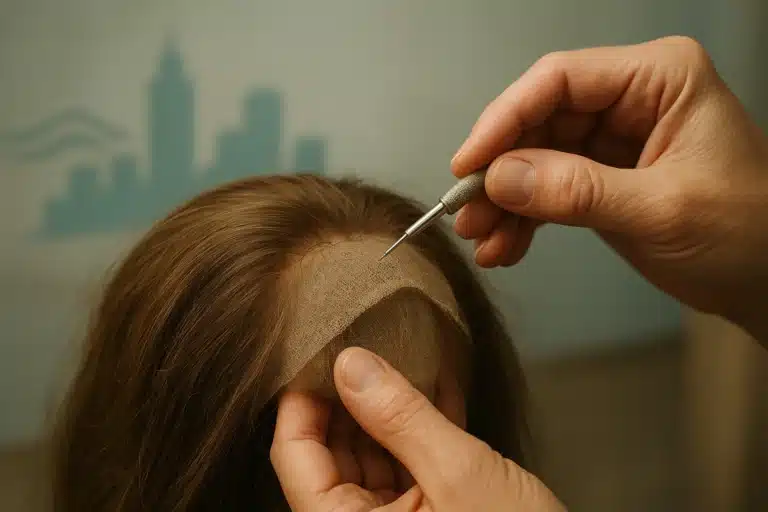
Moving up the ladder, we find the front lace wigs and monofilament tops. These constructions offer a sheer material at the hairline or crown where individual hairs are hand-tied to mimic natural growth.
- The Financial Pros: You get a natural look without the price tag of a fully hand-tied wig.
- The “Maintenance Tax”: It is important to note that lace fronts can carry hidden costs. Because the lace is delicate, it requires specific care. You may need to budget for specialized adhesives or tapes if you require extra security, as well as lace-safe removers.
- The Verdict: This is often the “sweet spot” for daily wearers, offering a balance of durability and realism. A monofilament top can extend the life of the wig because the multi-directional parting reduces the stress on specific fibers, preventing “pattern baldness” on the wig itself.
100% Hand-Tied: The Premium Strategy
At the top of the tier are 100% hand-tied caps, where every single hair is tied by hand into a soft mesh. While the upfront cost is highest, these are the “marathon runners” of the wig world.
- The Financial Pros: The cap is incredibly soft and moves like natural skin, reducing friction against your scalp. This lack of friction means less sweat and oil buildup, which translates to fewer washes. Since washing is the #1 stressor on wig fibers, washing less often extends the wig’s lifespan significantly.
- The Verdict: For those with total hair loss or sensitive scalps, this investment often pays for itself by eliminating the need for scalp-soothing creams, liners, and frequent replacements.
The Hidden Costs of “Budget” Wigs
When calculating your budget, you must account for the “Scalp Health Economics.” Cheaper caps often have coarser materials that can irritate a sensitive scalp.
If you opt for a basic cap but find it itchy, you will likely end up spending money on:
- Wig liners (bamboo or cotton)
- Scalp cooling sprays
- Anti-itch creams
Furthermore, there is the cost of time. A basic cap usually has “permatease” (crimped fibers at the root) to hide the machine wefting. While this gives volume, it can look less realistic, requiring you to spend more time styling or accessorizing (buying hats or scarves) to feel confident.
Calculating Your Personal ROI
To make a smart financial decision, consider the “9-Month Break-Even.”
Data suggests that a high-quality monofilament or hand-tied wig, when properly cared for, can outlast two to three budget-tier replacements. By the ninth month, the wearer who bought the premium wig has often spent less total money than the wearer who is on their third budget wig—and the premium wearer has enjoyed nine months of superior comfort and realism.
However, this ROI is entirely dependent on care. Even the most expensive wig will fail if treated poorly. Learning wig maintenance protocols is essential to protecting your asset. Using standard drugstore shampoo on a $400 wig is the equivalent of putting low-grade fuel in a luxury car; it will damage the engine.
![Image: An infographic timeline showing the “Break-Even Point” where a higher-quality wig becomes cheaper than replacing multiple budget wigs.]
Whether you choose synthetic or invest in human hair, knowing how to care for human hair wig types versus synthetic fibers is the final piece of the financial puzzle.
Frequently Asked Questions
Is a lace front wig always more expensive than a basic cap?
Generally, yes. The labor required to hand-tie the hairs into the lace front adds to the manufacturing cost. However, the result is a natural hairline that allows you to style hair away from your face, which many find worth the extra cost.
How long does a machine-made wig last compared to a hand-tied one?
With daily wear, a machine-made synthetic wig typically lasts 3 to 6 months before showing significant wear. A hand-tied wig, due to reduced internal friction and better ventilation, can often last 9 to 12 months or longer with proper rotation and care.
Can I save money by buying a human hair wig immediately?
Human hair wigs have a much higher upfront cost (often 3x-5x that of synthetic), but they can last over a year (sometimes two) with expert care. If you plan to wear hair for many years, human hair offers the best long-term CPW, but the initial “barrier to entry” is steep.
Do I really need special shampoo for my wig?
Yes. Wigs do not receive natural oils from the scalp like growing hair does. Regular shampoos are too harsh and will strip the fibers, making them brittle and causing the wig to “die” prematurely. Investing in wig-specific products is basically insurance for your wig.
taking the Next Step
Budgeting for a wig isn’t just about what you can afford today; it’s about planning for how you want to feel for the next year. By understanding the mechanics of wig construction, you can choose a cap that fits both your financial goals and your lifestyle needs.
If you are ready to explore which cap construction feels right for you, take some time to browse through the different categories and pay attention to the “cap construction” filter. Your perfect balance of comfort and cost is out there.