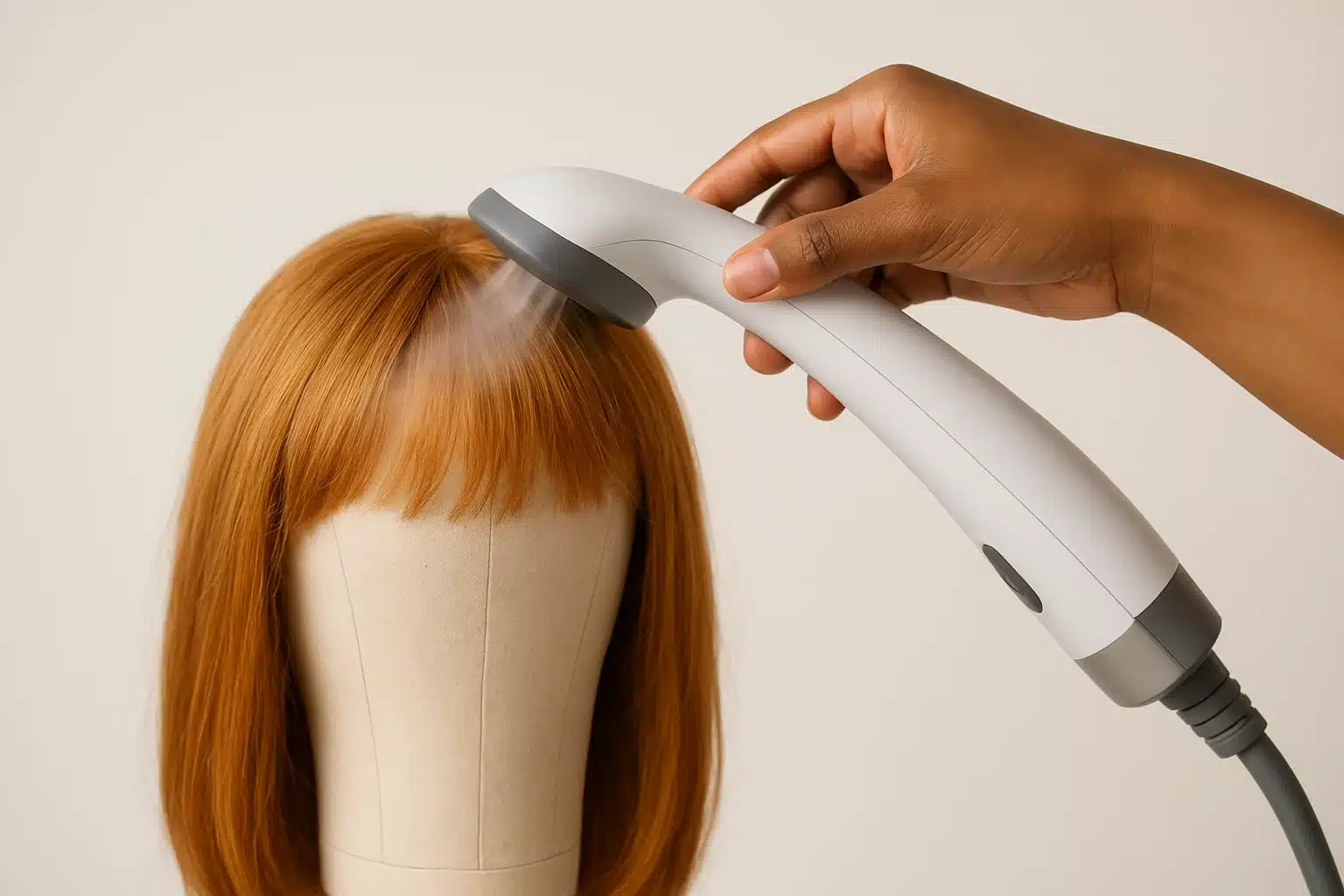
There is a specific moment of anticipation when you unbox a new wig. The color is perfect, the fiber feels luxurious, but when you put it on, something feels… slightly off. Perhaps the bangs are falling flat against your forehead, or the hairline has a bit too much “lift,” creating a dome-like shape that doesn’t quite match your natural silhouette. In the industry, we often call this “box hair”—a result of the wig sitting in packaging during shipment.
You might believe that once a synthetic wig is out of the box, its style is set in stone, unlike human hair which can be manipulated easily. However, mastering the art of Advanced Synthetic Wig Transformation & Re-Texturing allows you to break those factory molds. With the right technique, you can safely alter the fiber’s direction, lift, and flow to create a look that is uniquely yours. The secret isn’t an expensive styling tool; it’s likely sitting in your laundry room right now: a simple garment steamer.
The Science Behind the Steam: Why It Works
To master wig styling, it helps to understand the medium you are working with. Unlike human hair, which relies on breaking hydrogen bonds to change shape (which is why humidity ruins a blowout), synthetic hair is essentially a fine, high-quality plastic monofilament.
Synthetic fibers respond to what scientists call the “Glass Transition Temperature.” This is the specific temperature range where the hard plastic fiber becomes soft and malleable without melting.
Here is the “aha moment” that changes everything: Heat does not set the style; cooling does.
When you apply steam, you are gently heating the fiber to make it flexible. While it is warm, it will do whatever you tell it to do. But the style is only “locked in” once the fiber cools down completely. This is why holding the hair in place for a few seconds after removing the heat is the most critical step in the process.
Why Steam Beats the Flat Iron
If you search online, you will see many tutorials recommending low-heat flat irons or hot air brushes. While those tools have their place, we champion steam for beginners for three key reasons:
- The Safety Buffer: Direct metal-to-fiber contact carries a high risk. If your flat iron is 10 degrees too hot, you can permanently singe or melt the fiber effectively ruining the wig. Steam provides consistent, ambient heat that is hot enough to mold the fiber but generally safe enough to prevent melting.
- Moisture: Steam introduces moisture, which helps eliminate static styling friction—a common enemy of synthetic wigs.
- Root Lift: It is very difficult to get a flat iron right to the root of a wig without damaging the delicate cap construction. Steam can penetrate the roots to add or reduce volume with ease.
Your Styling Toolkit
Before you begin, gather these essentials. You don’t need a professional studio setup, but you do need stability.
- A Handheld Garment Steamer: Any standard travel or home steamer works.
- A Canvas or Styrofoam Wig Head: You cannot steam a wig while it is on your head (steam burns are serious!).
- T-Pins: To secure the wig to the head.
- A Rat-Tail Comb: For precise parting and directing fibers.
- Sectioning Clips: To hold hair out of the way.
Step-by-Step Steam Reshaping Guides
1. Flattening the “Cone Head” (Reducing Hairline Bulk)
One of the most common complaints is a hairline that looks puffy or “wiggy.” This often happens because the fibers are hand-tied to lift upward, or “permatease” (short, crimped fibers at the root) is slightly over-volumized.
- Pin it down: Secure the wig to your block head.
- Section: Separate the hair just behind the hairline.
- Steam: Direct the steam nozzle at the puffy area for 3-5 seconds. Keep the steamer moving to avoid soaking the cap.
- Press and Hold: Immediately put the steamer down. Use the spine (the flat back) of your comb or your hand (be careful of the heat!) to press the hair flat against the head shape.
- The Cooling Count: Hold that pressure for 10-15 seconds. You are waiting for the fiber to cool and lock into this flatter position.
2. Redirecting a Stubborn Part
Does your wig have a middle part, but you prefer a side sweep? Or perhaps the hair keeps flopping forward into your eyes?
- Dampen and Direct: lightly mist the root area with water. Comb the hair into the new direction you want it to go.
- Tension: Hold the hair taut in its new direction with your comb.
- Steam the Root: Apply steam directly to the root where you want the direction to change.
- Clip and Cool: While the hair is still warm, use a flat clip to pin the hair flat in its new direction. Leave it clipped until the fiber is completely cold to the touch. When you remove the clip, the “memory” of the part will have shifted.
3. Fixing Separating Bangs
Sometimes bangs tend to group together in “clumps” or separate in the middle, revealing the wig cap or forehead in an unflattering way.
- Cross-Combing: Steam the bangs, then comb them in an “X” pattern—comb the left side to the right, and the right side to the left.
- The “C” Shape: To create a natural curve (so bangs don’t stick straight out), steam the bangs, then roll them under with a round brush or a large roller.
- Cooling: Let them cool on the roller. When you unroll them, they will have a soft, natural bend that hugs the forehead rather than sticking out.
Troubleshooting: What Went Wrong?
Even with the safest methods, learning curves exist. Here is how to spot and fix common issues.
“The fibers look frizzy or crimped after steaming.”
- Diagnosis: You may have brushed the fiber while it was too hot, stretching the plastic, or held the steamer too close for too long.
- The Fix: Apply steam again to relax the fiber, and gently comb through with a wide-tooth comb to smooth it back out. If the fiber is actually melted (feels rough and hard like burnt plastic), it, unfortunately, cannot be repaired.
“The style fell out after 10 minutes.”
- Diagnosis: You didn’t let it cool long enough.
- The Fix: Patience is key. The “cooling set” is the most important step. If you remove the clip or stop holding the hair while it is still warm, it will revert to its original shape.
Frequently Asked Questions
Can I use this method on Heat-Friendly Synthetic hair?
Yes! Heat-friendly fiber is actually designed to withstand higher temperatures, so steam works beautifully. However, standard synthetic hair (which is not heat-friendly) responds even faster to steam, so use a lighter touch.
Will the style stay if I wash the wig?
This is the beauty of synthetic fiber. Once you have modified the style using heat and cooling (re-setting the memory), that style stays—even through rain, humidity, and washing—until you apply heat again to change it.
Is tap water okay for my steamer?
We recommend distilled water. Hard water minerals can build up in your steamer and “spit” white chalky deposits onto your wig, which can be difficult to clean off dark fibers.
The Path to Confidence
Learning to manipulate your wig’s fiber is the difference between wearing a wig and owning your look. By understanding the simple relationship between heat, tension, and cooling, you stop relying on the factory finish and start customizing your hair to frame your face perfectly.
We recommend trying these techniques on an older wig first to build your confidence. Once you master the steam, you’ll find that every wig has endless potential.