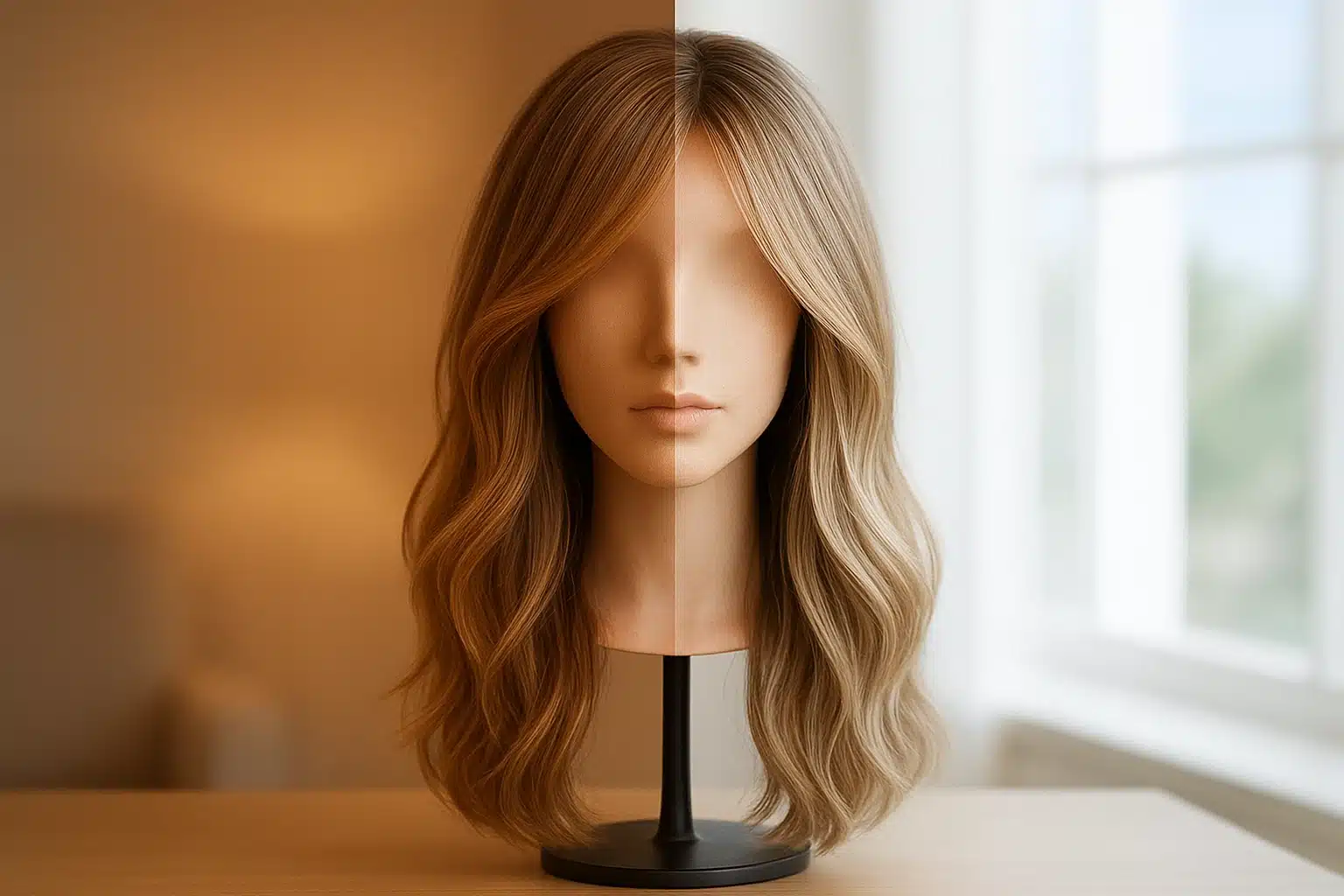
You’ve likely experienced the “Unboxing Paradox.” You spent hours researching, comparing swatches, and finally ordering the perfect shade of Honey Blonde. When the box arrives, you excitedly tear it open in your living room, only to feel a pang of confusion. The wig doesn’t look like the Honey Blonde on your screen—it looks warmer, almost strawberry. You walk into the bathroom to try it on, and suddenly, under the vanity lights, it looks ashier than you expected.
Is it the wrong wig? Did the manufacturer make a mistake? In almost every case, the answer is no. You are simply witnessing the physics of light in action. While Finding Your Perfect Wig Color: A Masterclass in Skin Tone Matching is the essential first step to choosing a flattering hue, understanding how that hue interacts with your environment is the secret to ensuring it looks perfect everywhere you go. This guide will walk you through the science of lighting so you can wear your hair with absolute confidence, indoors and out.
The Science of Sight: It’s All About “Temperature”
To understand why your wig changes color, you have to realize that light isn’t invisible. Every light source casts a specific color tint over everything it touches. This is known as Color Temperature, and it is measured in units called Kelvins (K).
Think of lighting like an Instagram filter that you can’t turn off.
- Low Kelvins (2000K – 3000K): This is “Warm” light. It acts like a Sepia filter, adding yellow, orange, and red tones to your hair.
- Mid Kelvins (3500K – 4500K): This is “Neutral” or “Cool White” light. It often has a slight green or blue tint, common in offices.
- High Kelvins (5000K – 6500K): This is “Daylight.” It is the crispest, bluest light and generally shows the most accurate version of a color.
When you look at a synthetic or human hair wig, you aren’t just seeing the pigment of the fiber; you are seeing the light bouncing off that fiber. If the light source is yellow, the hair will reflect yellow.
The Three Environments That Change Your Look
Most of us move through three distinct lighting environments every day. Here is how each one affects the perception of your wig.
1. Natural Sunlight: The Truth Teller
Color Temperature: ~5500K (Direct Sun) to 6500K (Overcast)
Natural sunlight is the gold standard. It provides the full spectrum of light, allowing the true dimension of the wig to shine through. This is where you will see the subtle highlights, the lowlights, and the true undertone of the color.
- The Effect: This is the most unforgiving but also the most beautiful light. It reveals the quality of the fiber. High-quality synthetic wigs will look vibrant and multi-dimensional here.
- The Trap: Direct, high-noon sunlight can sometimes be too harsh, creating strong shadows and making shiny synthetic fibers appear slightly more artificial (shiny). Overcast days or “Golden Hour” (just before sunset) offer the most flattering, soft light.
2. Incandescent & Soft White Bulbs: The Cozy Filter
Color Temperature: ~2700K
This is the lighting found in most living rooms, bedrooms, and restaurants. It is designed to be relaxing and flattering to skin tones because of its warm, amber glow.
- The Effect: Warm light suppresses cool tones. If you are wearing a cool “Ash Blonde,” it may appear remarkably golden or even yellow in your living room. Conversely, “Auburns” and “Chocolate Browns” look incredibly rich and vibrant in this light because the light source amplifies their natural red undertones.
- The Trap: If you judge a new wig solely in your bedroom at night, you might think a neutral shade is too warm. Always wait for daylight to make your final verdict.
3. Fluorescent Lighting: The Office Washout
Color Temperature: ~4000K
Common in office buildings, grocery stores, and hospitals, fluorescent lighting is notorious for being unflattering. It often has a spike in the green/blue spectrum.
- The Effect: This light can suck the warmth right out of a color. A beautiful “Golden Blonde” might look beige or flat. A “Strawberry Blonde” might lose its fire. It tends to make both skin and hair look a bit desaturated.
- The Trap: If you try on a wig in a bathroom with old fluorescent tube lights, you might panic thinking the color is dull. Step outside or move to a room with a window before you decide.
How Different Colors React
Not all wig colors react to lighting changes with the same intensity. Here is what you can expect based on your color family:
The Chameleon: Ash Blonde
Ash shades are the most sensitive to lighting changes. Because “Ash” is essentially a cool tone (often based on violet, blue, or green undertones to cancel out yellow), warm indoor lighting fights against it.
- Indoor (Warm Light): Looks neutral or sandy blonde. The ash disappears.
- Outdoor (Daylight): Looks true cool platinum or silver-blonde.
The Stabilizer: Dark Brunette & Black
Darker colors absorb more light than they reflect, making them more stable across different environments.
- Indoor: Reads as a solid, uniform color.
- Outdoor: The sun will reveal “hidden” undertones. A “Black” wig might suddenly show deep plum or midnight blue highlights that were invisible indoors.
The Shapeshifter: Red & Auburn
Red pigment has the longest wavelength in the visible spectrum, making it very reactive.
- Indoor (Dim): Can appear brownish or deep copper.
- Outdoor: Explodes with vibrancy. The difference between a red wig indoors and outdoors is often the most dramatic of all shades.
Practical Tips for the Savvy Wearer
Now that you understand the science, here is how to use it to your advantage.
1. The “North Window” Test
When your wig arrives, do not judge the color immediately after opening the box in your hallway. Take the wig to a window that gets indirect sunlight (North-facing is best). Hold it up or put it on a wig stand. This is the “True Color” of the unit. This is the baseline you should use to decide if you love it.
2. Dress for Your Destination
If you are buying a wig specifically for the office where you sit under fluorescent lights 8 hours a day, avoid shades that are already very ashy or cool, as the lights will make them look flat. Opt for a shade with slightly more golden or neutral tones—the office lights will “cool it down” naturally, resulting in a balanced look at your desk.
3. Photography Secrets
Taking a selfie to show your friends or a support group?
- Never stand directly under a ceiling light (creates “raccoon eye” shadows and distorts color).
- Always face a window. Let natural light hit your face and hair directly. This ensures the camera captures the color as the manufacturer intended.
Frequently Asked Questions
Why does the wig look different on my phone vs. my laptop?
Screens are calibrated differently. Most phones have a “blue light filter” or “night shift” mode that turns on in the evening, making everything look warmer (yellower). Always check wig colors on a screen with brightness turned up and night modes turned off.
Which lighting is “bad” for synthetic wigs?
While no lighting damages the color, direct, harsh spotlighting (like in some dressing rooms) can exaggerate the “shine” of synthetic fiber, making it look less realistic. If you are in a place with harsh lighting, a hat or a little dry shampoo can help matte down the shine.
I bought a “Rooted” color. Will lighting affect the roots?
Rooted colors are excellent for creating a natural look because the darker root helps ground the color. Dark roots are generally less affected by lighting changes than the lighter lengths, providing a consistent frame for your face regardless of the environment.
The Final Reflection
Finding the right color is a journey, and realizing that color is fluid is a major milestone in that journey. Your natural hair changes color in the sun, gets lighter in the summer, and looks darker in the winter. Your wig doing the same thing is not a flaw—it’s a sign of dimension and quality.
By understanding how light shapes perception, you can stop worrying about whether your wig “matches” the picture and start focusing on how beautiful it looks in the moment. Whether you are basking in the sun or enjoying a candlelit dinner, your confidence should shine the brightest.