When you first begin exploring the world of wigs, it is natural to focus entirely on the aesthetic: the cascade of curls, the precision of the cut, or the richness of the color. However, seasoned wig wearers know a secret that transforms the experience from merely “wearing a hairpiece” to feeling like you have your own hair back. The secret isn’t in the fiber—it is in the chassis. Much like a high-performance vehicle relies on a precision-engineered frame to handle the road, a high-quality wig relies on its internal framework—the cap—to handle your life.
The cap is the unsung hero of hair replacement. It is responsible for regulating temperature, preventing friction against sensitive skin, and ensuring the hair moves with the same fluidity as natural growth. Understanding the mechanics of how these caps are constructed allows you to predict how a wig will feel before you ever put it on. By learning the structural principles behind wefting, banding, and stretch panels, you gain the insight needed to appreciate the science of superior wigs: what separates a good wig from a great one? This guide deconstructs the engineering behind the beauty, helping you find the perfect balance of stability, fit, and ventilation.
The Three Pillars of Cap Engineering
Before diving into specific types of caps, it is helpful to understand the three engineering goals that manufacturers must balance in every design. Every innovation in wig construction serves one of these three masters:
- Stability (The Anchor): How the framework utilizes friction and tension to grip the scalp without causing headaches.
- Fit (The Contour): How the materials stretch and retract to mimic the unique curvature of the cranium, particularly the occipital bone at the back of the head.
- Ventilation (The Climate Control): How the structure manages heat transfer, allowing warm air to escape and cool air to circulate.
The Architecture of Airflow: Wefted Frameworks
The most common engineering method involves wefting. Think of a weft as a “curtain” of hair—fibers are sewn together into a long strip. In a basic cap construction, these strips are sewn onto a framework of elastic ribbons.
The Science of Open Wefting
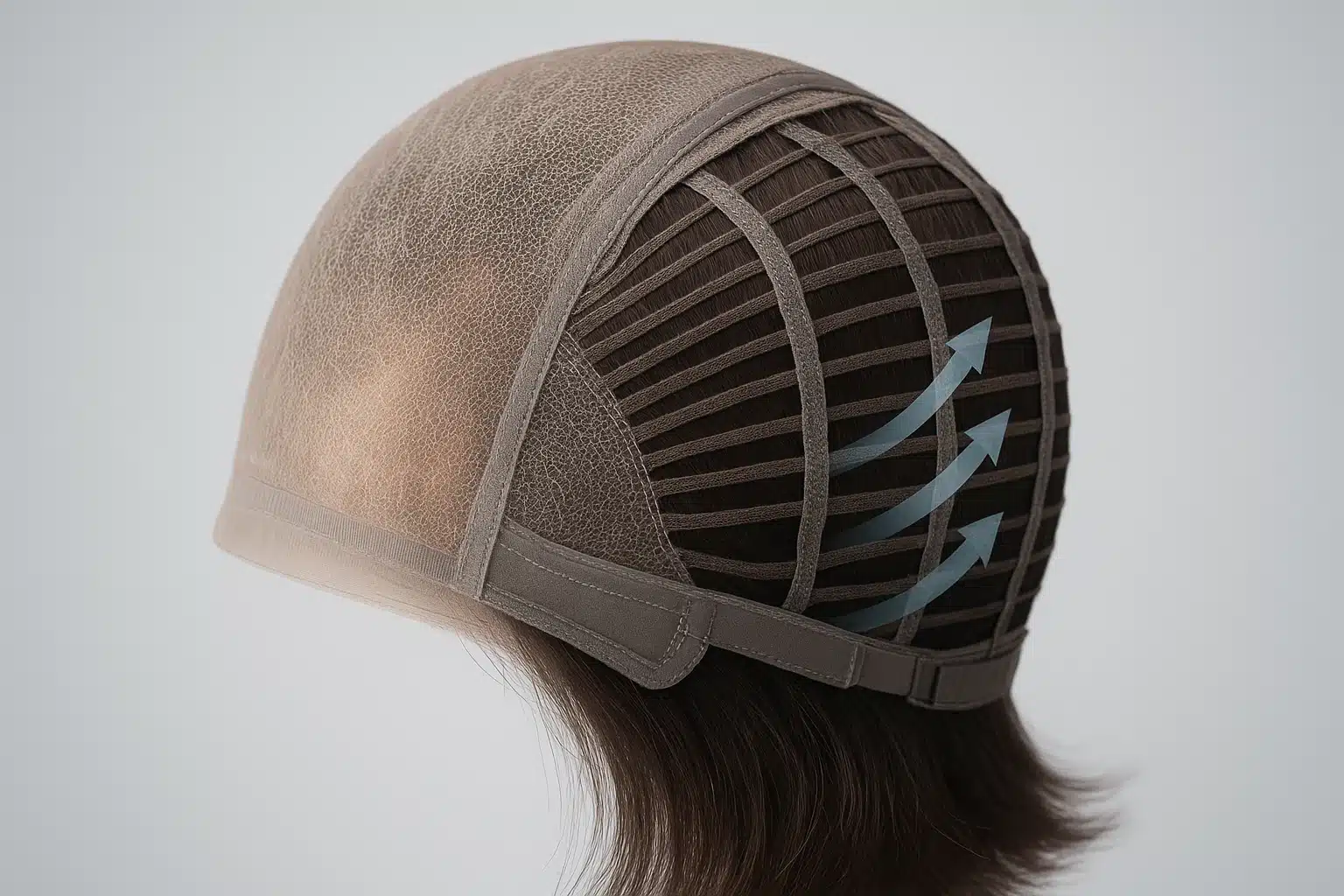
Early wig designs often utilized solid caps that trapped heat. Modern engineering has solved this through “open wefting” or “capless” construction. By sewing wefts onto thin, vertical elastic bands with significant spacing between them, engineers create physical channels for airflow.
From a physics perspective, this design utilizes convective cooling. As your body heat rises from your scalp, it passes through the open spaces between the wefts. Simultaneously, cool air can pass through the hair fibers to the scalp. This makes open wefted designs the primary choice for those seeking a cooling wig cap for warmer climates.
Structural Volume: The Role of Permatease
A common question regarding wefted wigs concerns the “teased” look at the root. This is not a styling error; it is a structural component known as Permatease. Because wefts are linear (rows of hair), they lack the natural lift of hair growing from a follicle. Engineers add a crimped layer of short fibers at the root to act as a scaffold. This structural layer holds the longer fibers up, providing permanent volume and concealing the cap material underneath without adding weight.
Biomimicry: Hand-Tied and Monofilament Innovations
While wefted caps are engineering marvels for ventilation and volume, they sometimes lack the multi-directional movement of natural hair. To solve this, manufacturers turn to biomimicry—designing materials that replicate biological processes.
The Mechanics of Movement
In a hand-tied cap, the “curtain” approach is abandoned. Instead, individual hairs or tiny clusters are tied by hand onto a mesh base. Structurally, this changes the physics of the hair movement. In a wefted wig, the hair moves as a unit (a row). In a hand-tied wig, each knot acts as a pivot point. This allows the hair to swivel 360 degrees, mimicking the behavior of a natural hair follicle.
This engineering is critical for types of wig caps where realism is the priority. The independent movement of fibers means that if the wind blows, the hair parts naturally rather than exposing a rigid row of stitching.
Monofilament: The Artificial Scalp
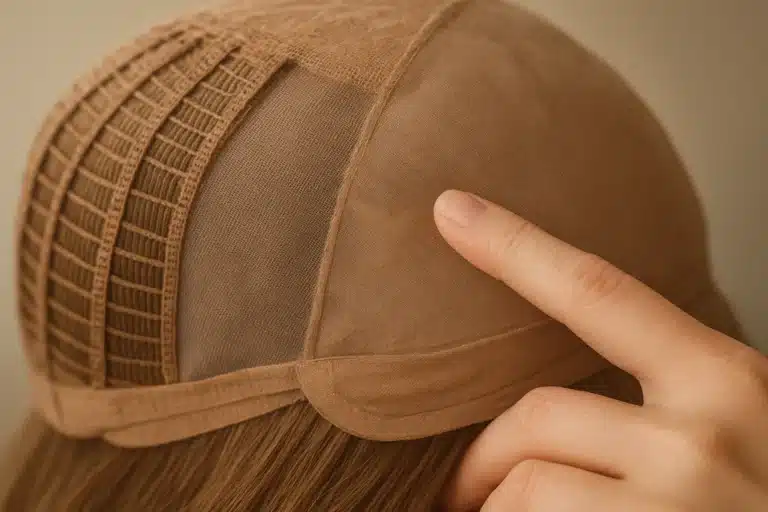
Monofilament tops utilize a fine, sheer mesh made from a single strand of fiber (hence “mono-filament”). This mesh is durable yet transparent. When hair is hand-tied into this mesh, the knot is nearly invisible. The engineering brilliance here is in the transparency; the mesh takes on the color of the scalp underneath it. Whether you part the hair on the left, right, or center, the mesh reveals your own skin tone, creating the illusion that the hair is growing directly from your scalp.
For those with complete hair loss, double monofilament layers are often used. A second layer of soft material is added beneath the knotted layer to provide a barrier between the knots and the skin, creating one of the most comfortable wigs for sensitive scalp issues.
Stability and Ergonomics: The Science of Fit
A wig cap is not a static object; it is a dynamic framework that must move with you. The fit relies on the manipulation of tension and friction.
Memory Cap Technology
Advanced caps use stretch lace or elasticized materials that feature “memory.” Much like high-end denim, these materials stretch to accommodate the head shape when worn and retract to their original size when removed. This constant, gentle retraction creates the tension necessary to hold the wig in place without adhesives.
The Occipital Lock
The back of the skull curves inward at the nape (the occipital bone). Well-engineered caps feature extended napes or adjustable straps (often using Velcro or hook-and-eye systems) that sit below this bone. By tightening the perimeter below the widest part of the head, the framework creates a mechanical “lock” that prevents the wig from riding up.
Frequently Asked Questions
Q: Why does my wig feel tight after a few hours?
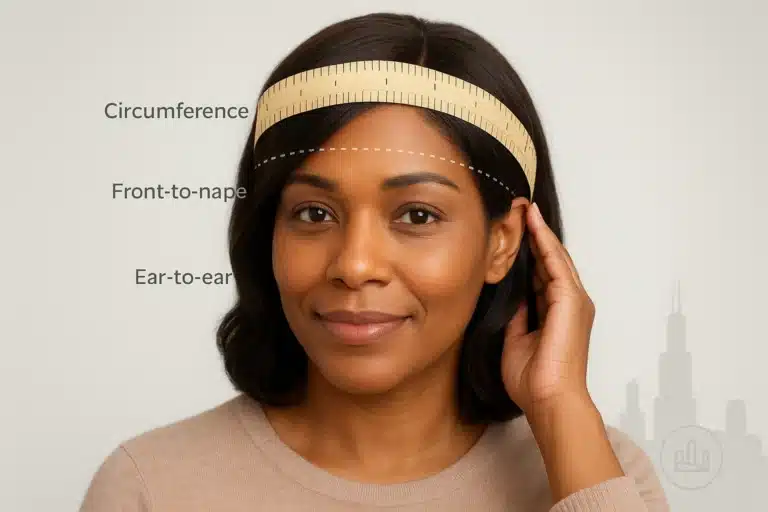
A: This is usually a tension distribution issue. If the cap is too small, the elastic framework is stretched to its limit, applying constant pressure. However, it can also be due to improper adjustment. Learning how to use a wig cap correctly involves adjusting the stays at the nape to ensure the tension is evenly distributed rather than concentrated on the temples.
Q: Which cap construction is the most durable?
A: Double monofilament and machine-wefted caps generally offer the highest durability. The delicate lace used in lace fronts and fully hand-tied caps is lighter and more natural but requires gentler handling to maintain the structural integrity of the mesh.
Q: Can I have both volume and a natural scalp look?
A: Yes. Many modern wigs employ “hybrid” engineering. They may use a monofilament top for a realistic part and natural movement, combined with wefted sides and back to provide the structural lift and volume that wefts offer.
Q: Do hand-tied wigs actually keep you cooler?
A: It depends on the material. Hand-tied wigs are lighter in weight, which can feel cooler. However, open-wefted wigs technically allow for more direct air circulation. If lightness is your definition of cool, go hand-tied. If airflow is your priority, open wefting is scientifically superior.
The Next Step in Your Education
Understanding the engineering behind the wig cap allows you to look past the style and assess the substance of the piece. You are no longer just buying a look; you are investing in a sophisticated architectural framework designed for your specific needs.
As you continue your journey, consider how your lifestyle intersects with these engineering principles. Do you need the durability of a wefted cap for daily wear, or the unparalleled realism of a hand-tied monofilament top? By matching your needs to the right construction method, you ensure that your wig doesn’t just look good—it feels like a natural extension of yourself.