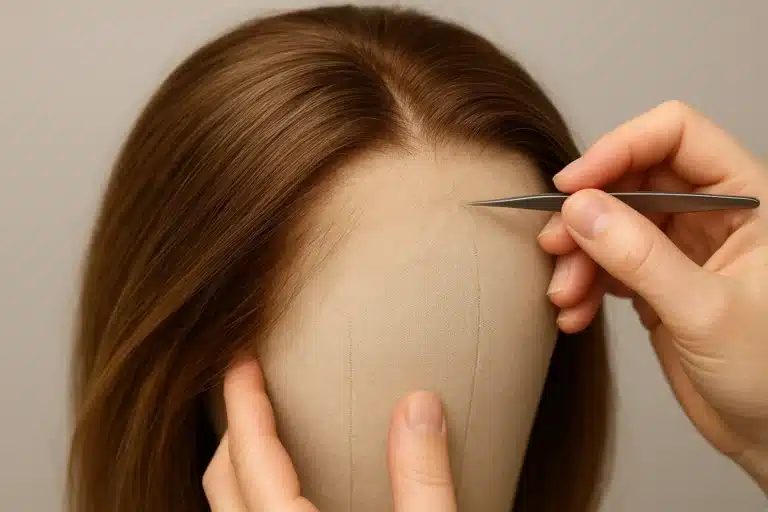
If you’ve ever looked in the mirror and felt like your wig was wearing you—rather than the other way around—you’re certainly not alone. For anyone navigating hair loss or simply exploring alternative hair, the biggest culprit of a “wiggy” appearance is the dreaded “wall of hair.” It’s that solid, impossibly dense line straight across the forehead that instantly gives away even the most beautifully colored unit. But today, achieving true realism goes far beyond the basic plucking tutorials flooding social media. It requires a shift from temporary styling tricks to what we call anatomical engineering.
When you look at the evolution of wig craftsmanship and materials, the leap from bulky, traditional caps to today’s ultra-fine HD lace and vellus-mimicking synthetics is staggering. We now have the technological canvas to create hairlines that are virtually undetectable. By understanding a few core principles of how natural hair actually grows, you can transform from a standard wig wearer into a skilled hairline architect.
Let’s grab a cup of coffee and explore the fascinating science and artistry behind crafting the ultimate natural hairline.
The Anatomy of Realism: The 90/110 Rule
To create a realistic hairline, we first have to understand biological hair growth. A natural hairline is never a solid curtain of thick hair. Instead, it features a distinct “Density Gradient.”
The hairs at the very front of our biological hairlines are finer, lighter, and more sparsely populated. As you move back toward the crown, the hair becomes thicker and denser. In the world of high-end wig artistry, we mimic this using the 90/110 Rule.
When customizing the front of your wig, the very edge should sit at about 90% density. Over the first half-inch moving backward into the unit, that density should gradually increase to 110%. Creating this gradual transition softens the face and completely eliminates the “wall of hair” syndrome.
Engineering the Foundation: Mastering Negative Space
One of the most tightly guarded secrets in theatrical and film wig-making is the concept of “negative space.” When beginners try to customize their wigs, they usually just pull out random hairs to thin it out. But true anatomical engineering is about creating intentional gaps.
If you closely examine a natural human hairline, you’ll notice it isn’t a perfectly straight or even line. It has jagged peaks, slight recessions, and areas where the scalp naturally peeks through. To replicate this:
- The W/Z Pattern: Instead of plucking straight across, part the front of the hair and pluck in a “W” or “Z” pattern.
- Intentional Gaps: Leave small, deliberate spaces that expose the lace (and your scalp beneath it).
This negative space tricks the eye. By showcasing beautiful irregularity, the brain registers the hairline as authentically human.
Temple Tab Geometry: Crafting the Perfect Sideburn
Most people view the temple tabs (the small flaps on the sides of the wig cap) purely as a structural feature to hold the wig in place. However, in hairline architecture, these tabs are your canvas for creating realistic temporal peaks and sideburns.
When these areas aren’t customized, it can lead to a blunt, unnatural edge near the ear. Addressing a proper wig fitting sideburns gap ensures that the hair transitions seamlessly into your face shape, allowing you to confidently tuck your hair behind your ears.
Furthermore, when the temple tabs sit flush and are correctly tailored to your facial geometry, they naturally anchor the unit. This creates the proper tension required for how to keep wig from slipping throughout your day, blending structural security with visual realism.
The Vellus Fringe: Rethinking Baby Hairs
Search the internet for wig styling, and you’ll find countless videos of heavily gelled, swooping “baby hairs” plastered to the forehead. While this can be a fun stylistic choice, it rarely mimics biological reality.
In dermatology, these tiny front hairs are called vellus hairs—they are shorter, finer, and softer than the terminal hairs that grow on the rest of your head. To achieve ultimate realism, your baby hairs shouldn’t look wet or heavy.
For those seeking wigs with natural hairline finishes, the goal is a soft, dry, and feathery fringe. You can achieve this by separating the very front hairs, trimming them at varying, staggered lengths with a razor comb (never straight across with scissors), and using a lightweight, dry texturizing spray instead of heavy gels.
The “Invisible” Finish: Advanced Techniques
The final step in hairline architecture involves blending the lace foundation into your skin tone perfectly. But before you apply any adhesives or tints, perform the Pinch Test. Pinch the lace at the center of your forehead; if it’s pulled so tight that you can’t pinch a tiny fold, it’s over-tensioned. Over-tensioned lace will stretch the delicate knots, causing premature shedding and a highly visible grid pattern.
Shadow Theory
For an incredibly realistic finish—especially for mature hairlines or those with natural recession—incorporate “Shadow Theory.” Use a matte eyeshadow or root powder that is one shade lighter than your wig’s root color. Lightly dust this powder directly onto the lace where the hair meets your forehead. This creates a soft, natural “shadow” that mimics the look of hair follicles sitting just beneath the scalp, blurring the line between lace and skin.
Pro Tip: Because customizing these delicate front sections involves plucking, razor-cutting, and frequent manipulation, the fibers here can easily become frayed. Knowing how to defrizz a wig will ensure those delicate, customized baby hairs stay soft, smooth, and incredibly natural over time.
Frequently Asked Questions About Hairline Architecture
How do I know if I’m over-plucking my wig?
The key to plucking is checking your work constantly. Pluck a few hairs, step back, and look in the mirror. You should always pluck the hair pulling in the direction the hair is tied, rather than pulling straight up, to avoid tearing the delicate HD lace. If you start to see noticeable bald spots rather than soft “negative space,” it’s time to stop.
Can I create realistic baby hairs on any type of wig?
Yes, but the technique differs based on the material. With human hair, you can use heat to train the hairs forward. With synthetic wigs, you must use low-heat tools (if the fiber is heat-friendly) or steam to carefully direct the fibers.
Why does my lace still show after I’ve plucked the hairline?
Lace visibility usually comes down to three things: a blunt cut, incorrect tinting, or adhesive buildup. Ensure you are cutting your excess lace in a jagged, irregular line rather than a straight circle. Additionally, use a powder or lace tint that matches your exact skin undertone (cool, warm, or neutral) to make the mesh truly disappear.
Your Next Steps as a Hairline Architect
At Wig Superstore, with nearly two decades of experience supporting our customers through hair loss and alternative hair exploration, we know that an incredibly realistic wig does more than just look good—it restores confidence.
Understanding the anatomy of a natural hairline shifts the power back into your hands. You don’t have to settle for the way a wig looks straight out of the box. By embracing the 90/110 density rule, utilizing negative space, and treating your temple tabs as a canvas for realistic sideburns, you can elevate your wigs to a standard of cinematic realism.
Take your time, practice these techniques with a gentle hand, and watch as your wigs transform from simply “worn” to truly, beautifully yours.