If you are navigating hair loss due to chemotherapy, alopecia, or naturally sensitive skin conditions like eczema, you know that the journey isn’t just about how you look—it’s about how you feel physically. There is often an unexpected physical tenderness that accompanies hair loss, transforming what should be a confidence-boosting experience into one of discomfort. You might find that fabrics that never bothered you before suddenly feel abrasive, or that your scalp reacts to temperature changes with intense sensitivity.
Many people focus entirely on the style of the wig, overlooking the critical importance of what goes underneath. However, establishing a routine focused on wig caps, liners, and scalp preparation is the true secret to long-term wearability. By shifting your focus from simply “covering up” to actively managing your scalp’s health ecosystem, you can eliminate the itchiness and irritation that often plague new wig wearers.
The Hidden Trigger: Why Standard Wigs Feel Different Now
When we think about wigs, we usually think about the hair fiber. But for those with sensitive scalps, the most important part of the wig is the interior construction. Standard wig caps are often machine-made with rows of wefts (curtains of hair) sewn together. For a biological scalp with hair, these wefts provide ventilation. However, for a bare or thinning scalp, the texture of these seams can cause “micro-friction.”
Micro-friction occurs when the wig shifts slightly during daily movement—talking, turning your head, or nodding. On a healthy scalp, hair acts as a buffer. On a sensitive scalp, this friction happens directly against the skin barrier. If you are undergoing chemotherapy, your skin cells are already turning over at a different rate, making the nerve endings hypersensitive. If you have psoriasis, this friction can trigger a Koebner phenomenon, where new plaques form at the site of irritation. Understanding that friction and heat are your primary adversaries is the first step toward comfort.
The Foundation: Scalp Health Before the Cap
Before you even select a wig cap material, you must address the canvas: your skin. A common misconception is that if you don’t have hair, you don’t need a “hair care” routine. In reality, you need a skincare routine specifically designed for occlusion (being covered).
For Chemotherapy Patients
Chemotherapy can dry out the skin significantly. However, using heavy, greasy lotions immediately before putting on a wig can degrade the elastic in the wig cap and trap bacteria. Instead, opt for a lightweight, fast-absorbing moisturizer designed for sensitive faces. Allow it to fully absorb for 20 minutes before putting on any headwear.
For Psoriasis and Eczema
The challenge here is balance. You need hydration to prevent flaking, but moisture trapped under a wig creates a humid environment that bacteria love. The solution is a “Cleanse and Barrier” approach. Ensure your scalp is clean and dry, then apply a thin layer of a barrier cream or a specifically designed scalp protector. This acts as an invisible shield, reducing the direct contact between your skin and the cap materials.
Material Science: Decoding “Hypoallergenic” Construction
Not all wig caps are created equal. When browsing for hypoallergenic wigs, you aren’t just looking for a label; you are looking for specific materials that govern temperature and texture.
Bamboo Viscose
This is often considered the gold standard for wig liners. Bamboo fiber is naturally round and smooth, meaning it has no sharp spurs to irritate the skin at a microscopic level. More importantly, it is highly hygroscopic—it wicks moisture away from the skin faster than cotton. For those experiencing hot flashes or night sweats, a bamboo liner can keep the scalp dry, preventing the “swampy” feeling that leads to itching.
Double Monofilament
In standard monofilament wigs, the hair is tied to a sheer mesh that mimics the look of the scalp. In “Double Monofilament” designs, a second layer of sheer, silk-like glass or soft mesh is sewn on the underside of the knotting. This extra layer serves two purposes: it protects your scalp from the prickly feel of the knots, and it creates a buttery-soft surface specifically designed for total hair loss.
The Architecture of Comfort: Cap Constructions that Heal
If you have a sensitive scalp, the way a wig is built (its construction) matters more than the style. There are two primary categories of construction that act as “medical-grade” comfort options.
100% Hand-Tied Caps
This is the pinnacle of comfort technology. Unlike machine-made wigs where wefts are sewn in rows, a 100% hand-tied cap involves artisans tying each hair individually to a stretchable mesh base.
- The “Aha” Moment: Because there are no wefts, the entire cap stretches like a high-quality fabric headscarf. It molds to the shape of your head without relying on tight elastic bands that can cause pressure headaches.
Monofilament Tops
For those who need breathability, monofilament tops natural part lines offer a blend of realism and airflow. The mesh material allows air to circulate directly to the scalp, which is vital for preventing heat rash.
The “Double Barrier” Method
For those with extreme sensitivity—such as raw skin from treatment or active dermatitis—the wig cap alone may not be enough. This is where the “Double Barrier” method comes in.
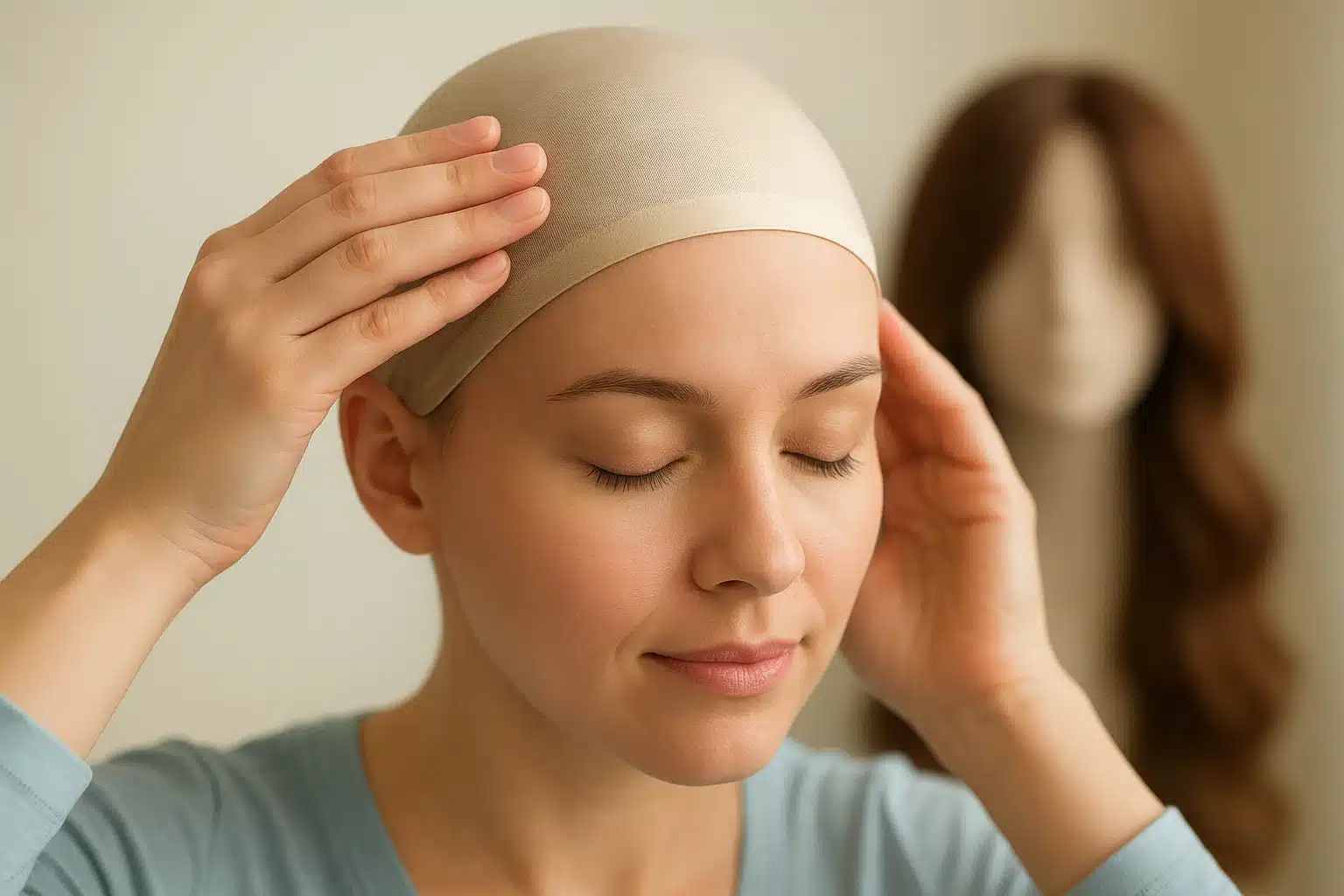
This technique involves wearing a separate, specialized wig liner underneath your wig. Think of this like wearing socks with shoes. You wouldn’t wear leather boots without socks; similarly, wearing a wig liner protects your skin from the construction of the wig and protects the wig from the oils of your scalp.
Using best wig cap liners made of bamboo or silk creates a sterile, washable barrier. You can change the liner daily, ensuring that a fresh, clean surface is always touching your sensitive skin, even if you only wash the wig itself once every 8-10 wears.
Choosing Your Protection Level
To help you navigate the vast options available, consider where you fall on the “Irritation Scale” and choose your solution accordingly.
Level 1: Mild Sensitivity / Thinning Hair
- The Sensation: Scalp feels normal but gets hot or itchy after a few hours.
- The Solution: A standard Open Weft wig cap for maximum ventilation, paired with a thin nylon or mesh liner to keep the wig secure.
Level 2: Active Treatment / Complete Hair Loss
- The Sensation: Scalp is tender to the touch; you may have “chemo hair” that hurts when moved.
- The Solution: Comfortable wigs for sensitive scalp featuring a Double Monofilament top. The extra layer of softness cushions the hair knots. Avoid standard nylon liners; switch to a bamboo liner for thermal regulation.
Level 3: Hyper-Sensitive / Post-Surgical / Psoriasis
- The Sensation: Skin feels raw, inflamed, or painful. Even light pressure creates discomfort.
- The Solution: A 100% Hand-Tied cap. The four-way stretch eliminates pressure points. Utilize the Double Barrier method with a seamless silk or bamboo liner to ensure zero friction against the skin.
Frequently Asked Questions
Q: Will wearing a wig liner make me hotter?
A: It depends on the material. A cotton or thick nylon liner might retain heat. However, a high-quality bamboo or aloe-infused liner can actually cool you down by wicking sweat away from the skin, allowing it to evaporate rather than trapping it against your scalp.
Q: Can I wear a wig if I have open psoriasis sores?
A: It is generally best to let open skin breathe and heal. However, if you must wear a wig, avoiding direct contact is non-negotiable. Use a clean, medical-grade bamboo liner as a bandage-like barrier and limit wear time. Consult your dermatologist for specific topical treatments that are safe to use under occlusion.
Q: How often should I wash my wig cap/liner?
A: If you wear a separate liner, it should be washed after every wear, just like undergarments. This prevents the buildup of bacteria and yeast which are the primary causes of “wig itch.” The wig itself generally needs washing every 6-8 wears.
Your Path to Comfortable Wear
Finding the right combination of scalp preparation, liner material, and cap construction is a personal journey. It often takes a little experimentation to find the “cocktail” that works for your unique skin chemistry.
Remember, you do not have to endure discomfort for the sake of beauty. By prioritizing wigs for sensitive scalps and treating your scalp with the same care you treat your face, you can achieve a look that feels as natural and comfortable as it looks. Start by assessing your current scalp health, and consider trying a bamboo liner as your first step toward a friction-free experience.