Imagine stepping out on a breezy day. The wind picks up, and instead of enjoying the fresh air, your heart races with one specific fear: “Is my wig going to slip?” For many, this anxiety is the biggest barrier to feeling truly like themselves. But here is the secret that seasoned wig wearers know: confidence doesn’t come from the wig itself; it comes from the security of the foundation underneath it.
Just as a house needs a solid foundation to stand tall, your wig requires the right interface between the hairpiece and your skin. Whether you are navigating hair loss due to medical reasons or simply exploring new styles, understanding the nuances of wig caps, liners, and scalp preparation for optimal wear is the key to transforming your experience from “bearable” to “beautifully comfortable.”
The Foundation of Confidence: The “Interface” Explained
When we talk about what goes under a wig, we are discussing the “interface.” This is the crucial layer that manages friction, sweat, and security. Historically, the conversation has been binary: you either glued the wig down or hoped for the best. Today, however, we have a spectrum of solutions designed to address specific pain points, from tension headaches to sensitive scalps.
The two primary players in this space are the Wig Cap (the barrier) and the Wig Grip (the anchor). Understanding the distinct roles of each—and knowing when to combine them—is how you achieve that “barely there” feeling.
The Wig Cap: Your Protective Barrier
The humble wig cap is often misunderstood. Many beginners assume it is strictly for tucking away biological hair, but its role goes much deeper. It serves as a hygiene layer, protecting your wig from scalp oils, and creates a uniform surface for the wig to sit upon.
Understanding Material Science
Not all caps are created equal. The material you choose should correlate directly with your skin sensitivity and heat tolerance.
- Nylon: The industry standard. It’s lightweight and effective for containing biological hair. However, if you are prone to overheating, nylon can trap warmth.
- Mesh: If you find yourself asking, “Why is my head so hot?”, a mesh liner might be your solution. These offer superior airflow and are ideal for warmer climates or active lifestyles.
- Bamboo & Cotton: For those undergoing chemotherapy or dealing with alopecia, the scalp can be incredibly tender. Synthetic materials like nylon can feel abrasive. Bamboo is a standout here; it is naturally antibacterial, incredibly soft, and moisture-wicking, making it a superior choice for wigs for sensitive scalps.
To dive deeper into the construction of these foundations, it is helpful to explore the different types of wig caps available, as the construction method often dictates the comfort level.
The Wig Grip: Your Security Anchor
While the cap protects, the grip secures. The invention of the wig grip revolutionized the industry by eliminating the need for tapes and glues for many wearers.
The Physics of Friction
How does a simple band keep a wig from sliding? It comes down to friction coefficients and texture.
- Velvet Grips: These rely on “directional nap.” If you run your fingers one way, it’s smooth; run them the other way, and it catches. This resistance is what grabs the material of the wig cap, locking it in place against the natural movement of your head.
- Silicone Grips: These work through suction and high-friction contact. A suction silicone wig cap or band is particularly effective for those with total hair loss, as it adheres gently to the skin without the chemical irritation of adhesives.
The Decision Matrix: Which Solution Fits Your Needs?
Choosing between a cap, a grip, or a combination depends largely on your “biological landscape”—specifically, how much hair you have and your scalp’s sensitivity.
Scenario A: Total Hair Loss (Alopecia or Chemotherapy)
- The Challenge: The scalp is sensitive, slippery, and perhaps prone to temperature fluctuations.
- The Solution: Prioritize softness and suction. A bamboo liner under a silicone-lined grip offers the best of both worlds: protection for the skin and security against the smooth scalp.
- Avoid: Rough mesh directly on the skin, which can cause irritation.
Scenario B: Biological Hair (Thinning or Full)
- The Challenge: Hair needs to be contained flat to prevent a bulky look, and the wig needs to grip onto something other than hair (which is slippery).
- The Solution: A mesh or nylon liner to contain the hair, topped with a velvet wig grip. The grip acts as a buffer, preventing the wig from sliding back on your bio hair.
- Tip: If you have long hair, braiding it flat against the head before applying the wig liner creates a more natural silhouette.
The Hybrid Approach: The “Sandwich” Technique
For maximum security without the use of hypoallergenic wig glue, many veteran wearers use the “Sandwich Technique.”
- Layer 1: A thin, breathable liner (to manage sweat and protect hair).
- Layer 2: The Wig Grip (placed over the liner to anchor the system).
- Layer 3: The Wig.
There are also “Grip Caps” available—hybrids that sew the velvet grip directly onto a soft cap. This eliminates the bulk of multiple layers and is an excellent option for those who want a “grab and go” solution.
Best Practices for Comfort and Placement
Even the best hypoallergenic wigs can feel uncomfortable if the foundation isn’t positioned correctly.
The 4-Finger Rule
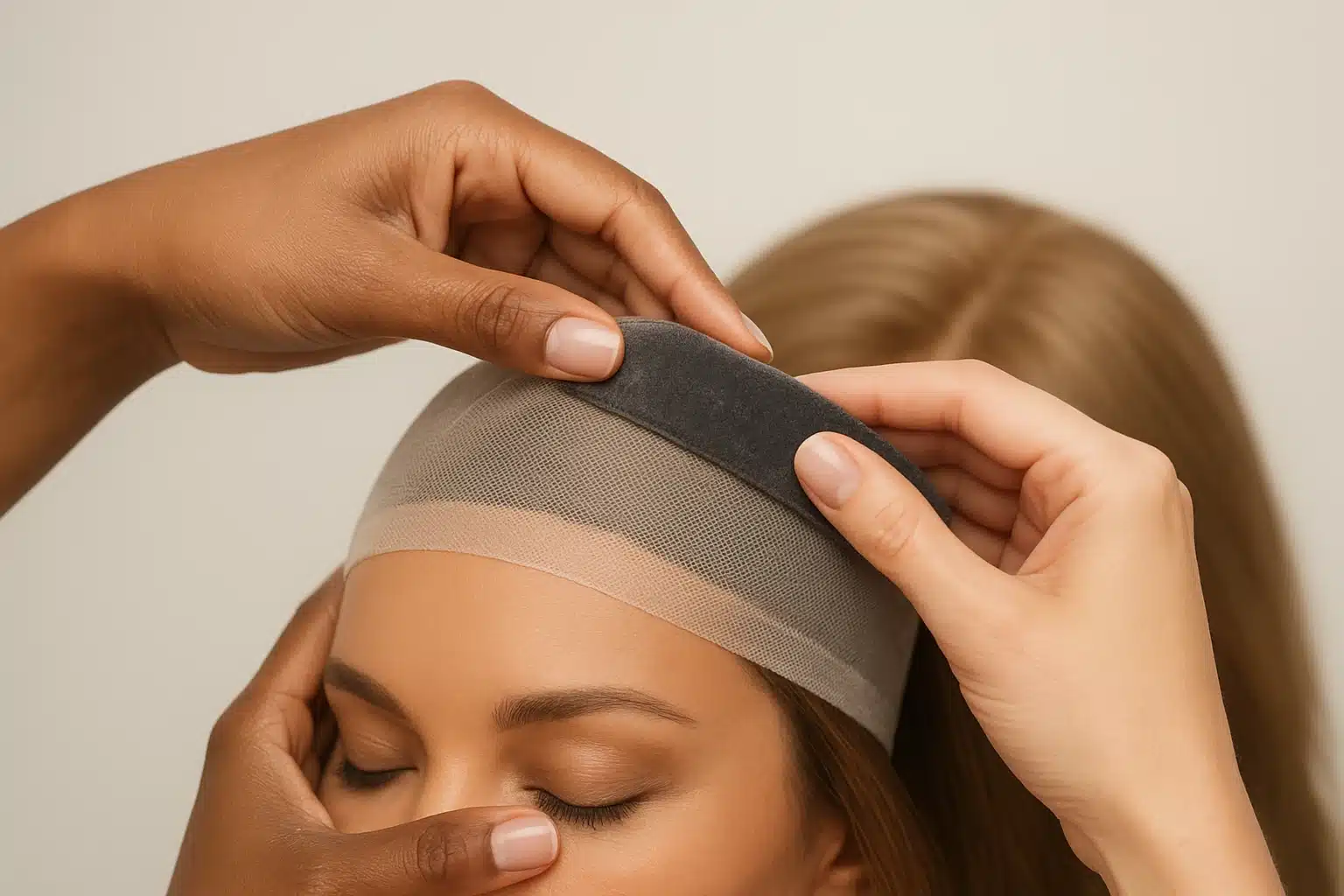
A common mistake is placing the grip too far forward, interfering with the natural hairline, or too far back, causing the wig to slip. Place your grip four fingers width above your eyebrows. This usually lands exactly where your hairline naturally begins (or would begin), ensuring the wig sits anatomically correctly.
The Pinky Test (Preventing Headaches)
The “wig headache” is almost always caused by excessive tension. Once your grip or adjustable cap is on, slide your pinky finger under the band. It should slide in easily without forcing it. If it’s a struggle, your securement is too tight. Remember, the friction holds the wig, not the constriction.
Frequently Asked Questions
Q: Do I really need a wig cap if I’m wearing a grip?
A: Not necessarily. If you have total hair loss, you might prefer just a soft grip. However, a cap helps keep wigs cleaner for longer by absorbing oils and sweat before they reach the delicate hand-tied knots of the wig.
Q: Can a velvet grip work on a bald head?
A: Yes, but silicone is generally superior for bald scalps due to the “suction” effect. Velvet requires some tension to stay in place, which can sometimes slip on very smooth skin.
Q: How do I wash my wig grip?
A: Treat it like fine lingerie. Hand wash with cold water and mild detergent, then air dry. Putting a velvet grip in the dryer can damage the fibers, ruining the “directional nap” that provides the security.
Moving Forward in Your Journey
Finding the right securement method is a personal journey of trial and error. What works for a gym session might not be what you want for a dinner date. By understanding the materials available to you—from cooling mesh to gripping velvet—you can curate a wearing experience that makes you forget you’re wearing a wig at all.
When your foundation is secure, your confidence follows suit.